
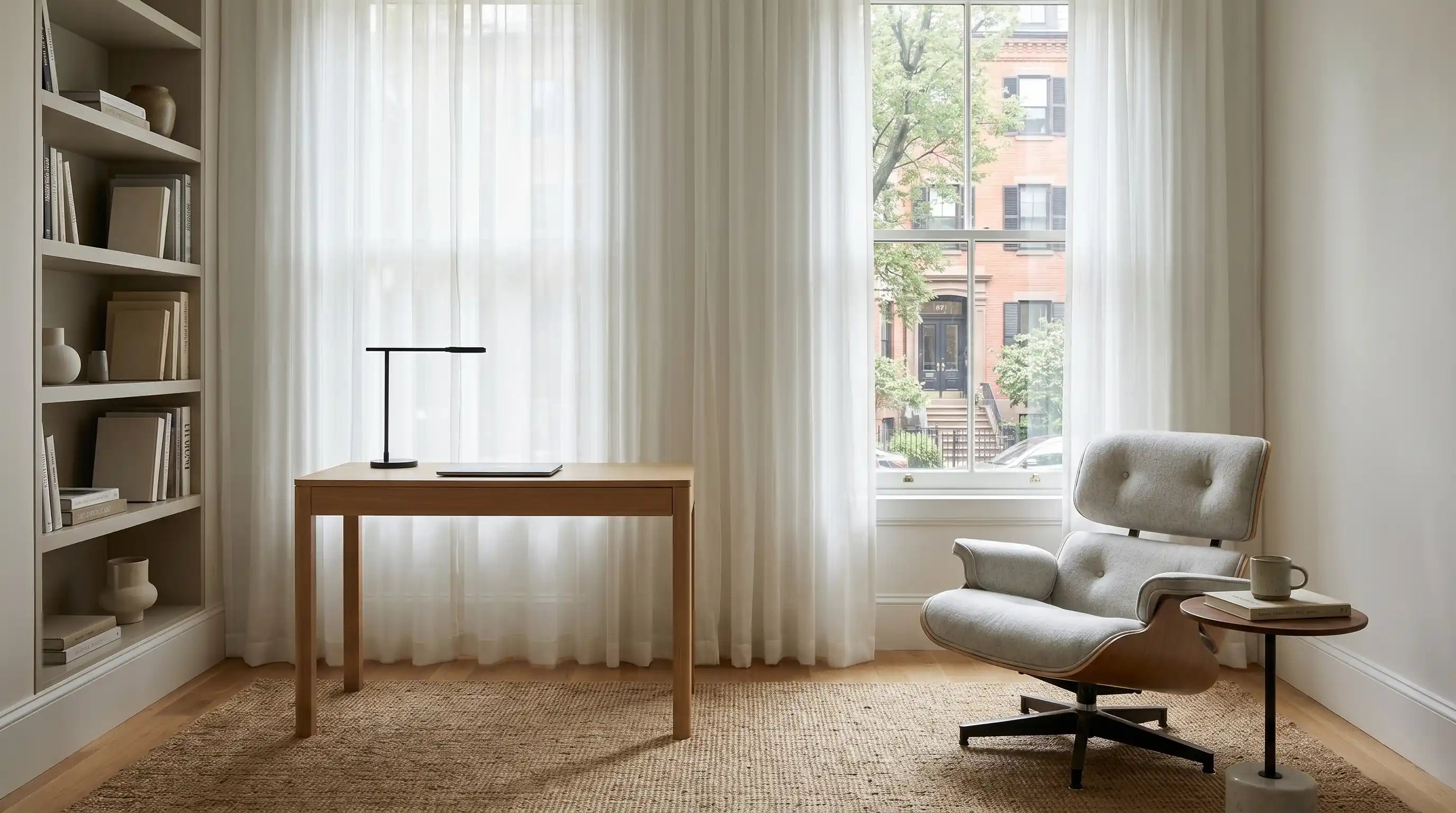
A home office window is doing more work than it might appear. It's managing glare on a screen, shaping the background of every video call, and contributing to whether the room feels like a place you actually want to spend focused time in. Get the curtain right and it quietly supports all of that. Get it wrong and it becomes a daily friction point you stop noticing only because you've learned to live with it.
Here's a more practical way to think through home office curtain ideas.
Glare Control Is the Real Starting Point
Screen glare is the most immediate functional problem a home office curtain needs to solve. Direct sun hitting a monitor makes it nearly impossible to work, and even indirect glare can cause eye strain over a long day. This is the one requirement that should narrow your options before anything else.
The solution isn't necessarily a blackout curtain — in fact, a room that's too dark can feel oppressive and make it harder to stay alert. What you want is a light-filtering treatment that takes the edge off direct sun without eliminating daylight entirely. Sheer curtains in a medium-weight fabric do this well: they diffuse rather than block, keeping the room bright while reducing the harshness of direct light. For rooms with stronger sun exposure, a lined panel gives you more control — you can close it fully when the sun is at its worst and open it again once it shifts.

A Background That Looks Good on Camera
This is a consideration that didn't exist for most people five years ago and now matters almost every day. The curtain behind you — or visible in the frame — is part of how you present professionally on video calls. A wrinkled, ill-fitting, or visually busy curtain reads as careless even when everything else about the call is polished.
The best video call backgrounds are calm and neutral. A well-hung panel in a solid, muted tone — warm white, soft grey, greige, or a quiet earthy color — reads as considered without drawing attention to itself. Linen curtains work particularly well here: the texture is visible enough to look intentional on camera, but the overall effect is quiet and professional.

Clean Lines That Help the Room Feel Focused
A home office benefits from visual calm. Unlike a living room where layering and texture are part of the appeal, a workspace tends to function better when there's less visual noise. That means the curtain should be well-proportioned, hang cleanly, and not compete with the things in the room that actually matter — your desk, your shelving, your work.
Simple heading styles — eyelet, rod pocket, or a clean pinch pleat — tend to work better than more decorative options. The fabric should hang with minimal wrinkling; linen and cotton curtains both do this well when properly weighted at the hem.
Color-wise, the same principle applies: choose something that recedes rather than asserts. If the walls are neutral, the curtain can be a slightly warmer or cooler version of the same tone. If the room has more color, a true neutral curtain gives the eye somewhere to rest.
Getting the Proportions Right
The same rules that apply in every other room apply here: hang the rod high, extend it wide, and let the fabric reach the floor. In a home office, this matters for an additional reason — a curtain that's properly proportioned makes the room look more deliberate and finished, which is exactly the impression you want to project on camera and to yourself while you're working.
If your office has non-standard windows, or if you want a result that fits precisely without any compromise, custom curtains are worth the investment. A panel that's the right width and length for your specific window will always look better than one that's been adapted to fit.

Final Thoughts
Home office curtain ideas come down to three things: managing light so you can actually work, looking composed on camera, and keeping the room visually calm enough to stay focused in. When the curtain handles all three, it stops being something you think about and starts being something that just makes the room work better — which is exactly what good design is supposed to do.